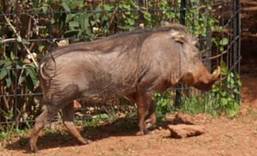
Phacochoerus - Wart
Hogs
|
Scientific name |
Phacochoerus
africanus Phacochoerus
aethiopicus |
||||
|
Global distribution |
P. africanus – open
country – P. aethiopicus – |
||||
|
Habitat |
Open country |
||||
|
Conservation status |
Several subspecies have recently become extinct. However, both main species are widespread throughout their range. |
||||
|
Physical characteristics |
Body size |
Head and body length 900-1500 mm Shoulder height is 635 – 850 mm Weight is 50 -150 kg P. africanus is generally larger than P. aethiopicus |
|||
|
Weight |
50 to 150 kg |
||||
|
Colouring |
The body covered with bristles. Colour of the skin and hair is dark brown to redish. The long ridge like fold on the cheek bears white hairs. |
||||
|
Hair |
Long thin mane of coarse hair extends from the nape to the middle of the back, where it is broken up a bare space and then continues on the rump. |
||||
|
Piglets |
Redish brown |
||||
|
Tail |
250 – 500 mm. Tail hangs limply when the pig walks, but is held upright, with the tufted tip handing over, when the pig runs. |
||||
|
Tusks |
Upper tusk is 255-635 mm in males and 152-255 in females. |
||||
|
Warts |
Prominent only on the males, are skin growths and has no bony support or core. They are located on the side of the head and in front of the eye. |
||||
|
Phacochoerus aethiopicus |
|||||
|
|
|
|
|||
|
Female – side
view |
Neck and face |
rear |
|||


|
Phacochoerus
africanus |
|||||||||
|
|
|
|
|||||||
|
Female – side
view |
Face view |
Rear |
|||||||
|
|
|
||||||||
|
Red hair
colouration by water hole |
Carriage of the
tail during running |
||||||||
|
|
|
||||||||
|
Detail of face
male |
Detail of
teeth. The lower tooth is actually the
weapon of choice by the wart hog, the top tooth is blunt. |
||||||||
|
|
|
||||||||
|
Detail of the
mane |
|||||||||
|
Anatomical points |
Peculiarities |
3rd Molar composed on set of cylinders of dentine set in cement |
|||||||
|
No upper incisors in P. aethiopicus |
|||||||||
|
Glands |
Glands under the eyes |
||||||||
|
Dental formulae |
P. africanus: (i1/3, c1/1, pm 3/2, m 3/3) x 2 = 34 P. aethiopicus (i0/3-0, c1/1, pm 3/2, m 3/3) x 2 =
32-26 |
||||||||
|
|
|
||||||||
|
P. aethiopicus skull and detail of canines and premolar/molar
teeth. |
|||||||||
|
The skull is huge compared with others of the
subfamily Suinae. Skull is triangular in dorsal outline, broad at the back
and narrowing towards the front. The braincase is shortened, the zygomatic
arch deepened. The ascending process
of the mandible elongated and the maxilla considerable deepened to
accommodate enlarged, very hypsodont molar teeth. The third molar are unlike other mammal teeth, they
are composed of a number of closely set cylinders of dentine embedded in
cement. The lower tusks do not wear down the tips of the
upper tusks, which are long and curved.
P. africanus always has two upper incisor teeth and
usually six functional lower incisors. P. aethiopicus never has upper incisors and when lower incisors are present they are rudimentary and nonfunctional. |
|||||||||
|
Behaviour points |
Maturing age |
Maturity reached at 18-20 months. Males mate at around 4 years of age. |
|||||||
|
Mating ritual |
Adult males are usually solitary and join the
females for mating |
||||||||
|
Males fight by highly ritualized battles, in which
they push and strike with their heads and their blunt upper tusks. The warts on the side of their heads act as
cushions and injuries are rare. |
|||||||||
|
Seasonal breeding |
Clearly defined breeding seasons. Mating occurs 4-5 months after the breaking
of the rains and births mainly in the dry season. |
||||||||
|
Oestrus period |
Females are polyoestrus, oestrus lasting about 72
hours at intervals of 6 weeks. |
||||||||
|
Gestation period |
150 – 175 days |
||||||||
|
Birth weight |
400 to 900 grams |
||||||||
|
Litter size and lactation |
1 to 8 piglets (usually 2-3). |
||||||||
|
Weaning age |
Piglets accompany their mother regularly at 50 days
and are completely weaned by 21 weeks |
||||||||
|
The young are temporarily driven away when the
female is about to bear a new litter.
The weaned piglets may rejoin the sounder. |
|||||||||
|
Males separate from their mother at 15 months. Females may stay in permanent association. |
|||||||||
|
Family groups |
|
||||||||
|
Cooling behaviour |
Wart Hogs enjoy mud baths |
||||||||
|
Peak activity |
|
||||||||
|
|
Maximum running speed |
55 km/hr |
|||||||
|
Visual capabilities |
Its eyesight seems poor, but its sense of hearing
and smell are acute. |
||||||||
|
Population densities |
0.2/sq km to 20.0/sq km. Home range varies from 64 to 374 ha. |
||||||||
|
The population is divided into ‘clans’ each
consisting of several sounders (or bands) and single individuals |
|||||||||
|
A sounder consists of 4 to 16 individuals with up to
40 reported. |
|||||||||
|
Marking sites |
Saliva may be used as a marker. Secretions from glands around the eyes |
||||||||
|
Lying down |
|||||||||
|
|
|||||||||
|
Note the pig sits on its front kneels, lowers its
back end and then has all four feet under their body. They then lie down on the side. |
|||||||||
|
Diet |
Feeds on grass, roots, berries, the bark of young trees and occasionally carrion. |
||||||||
|
|
When feeding Wart Hogs frequently will drop on their padded wrists and frequently shuffle along eating and looking for food. |
||||||||
|
Diseases/ disorders |
Rinderpest can cause widespread deaths. |
||||||||
|
Age |
A captive wart hog has lived to 18 years and 9 months |
||||||||