Greasy Pig Disease
|
Other names |
Exudative
epidermitis |
||
|
Causal agent |
Staphylococcus hyicus plus fighting |
||
|
Age group |
3-20 kg
typically.
A chronic form may be seen in adults. |
||
|
|
At any age
wounds that do not heal properly may have a localized region of greasy pig
disease |
||
|
Clinical
signs |
|||
|
Classic
Picture |
Newly weaned pig
suddenly presents covered in patches of dirty brown greasy wet skin. The hair is matted and may become a gray
colour. The condition extends
rapidly, covering the whole body. The
pig stops eating and drinking and becomes very dehydrated. After a week to 10 days the pig may be
found dead. |
||
|
|
|
|
|
|
Chronic |
The pig presents
with patches 3-5 cm of the above skin condition but the disease does not
spread. The condition is most
common/severe affecting the upper neck and hind legs - areas where the pig’s
fight |
|
|
|
Piglet |
Facial necrosis is a form of greasy pig disease associated with poor milk
output resulting in excessive fighting between the piglets and damage to the
face |
|
|
|
Adults |
A chronic black
spotty appearance on the back and neck of sows is often associated with Staph. hyicus. |
||
|
Infectivity |
|||
|
|
Nearly all pigs
carry Staph. hyicus on their
skin. |
||
|
Infection is
from the mothers shortly after birth.
Infection can even occur during birth |
|||
|
Post-mortem
Lesions |
|||
|
|
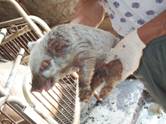
A severe if
local exudative epidermitis. |
||
|
In severe acute
cases lymph nodes may be swollen and abscessed. |
|||




|
Diagnosis |
|||||
|
|
Clinical
examination of the animal |
||||
|
Culture
relatively meaningless as culture from normal skin also positive |
|||||
|
Treatment |
|
||||
|
Individual |
Isolate and place
in compromised pig pen |
|
|||
|
Inject with a
staphylococcus active antimicrobials which concentrate in the skin –
lincomycin
for example |
|
||||
|
Wash pig in
Savlon or other disinfectant. Ideally with Lanolin in the wash to soothe
the skin |
|
||||
|
Inject with
multivitamins |
|
||||
|
Provide ad lib
water through cube drinkers and if necessary provide extra water by
mouth. The animals are quite
dehydrated. Note a pig may drink 1 litre
per 10 kg, therefore a couple of syringe fulls will not be significant |
|
||||
|
Provide heat
from a light source and clean dry straw |
|
||||
|
Control |
Greasy pig disease is the end result of fighting
|
|
|||
|
Review all causes
of fighting and increased aggression |
|
Fighting
over water |
|
||
|
Check feed space
availability |
|
||||
|
Check water
supply number of drinkers and speed of flow |
|
||||
|
Check for
draughts and piling |
Fighting over
feed space |
|
|||
|
On rare
occasions it has been necessary to change genetics to a more sociable pig |
|
||||
|
Reduce mixing
and moving |
|
||||
|
Check fly
control in particular look for biting flies – Ophyra calcitrans |
|
||||
|
In herd
‘outbreaks’ it is possible to control by adding lincomycin to the water
supply together with a sweetener to encourage the pigs to drink |
|
||||
|
Control mange on the farm |
|
||||
|
Ensure feedback adequate - especially to control cases in farrowing house. Review colostrum mangement |
|||||
|
Common differentials |
|
||||
|
|
Severe
Pityriasis rosea, parakeratosis associated with zinc deficiency
Mineral
deficiencies – generally a milling mistake |
|
|||
|
Zoonotic implications |
|
||||
|
|
There are no
zoonotic implications |
|
|||

