Gestation
housing to ensure each batch farrowing place is full
Example
– 20 farrowing places a week batch farm
The difference between the farrowing place requirement and the breeding
place requirement is determined by the farrowing rate. This can be used to design a gestation area
which minimises sow movement.
Create enough stalls or pens in the gestation area equal to the
farrowing places per batch multiplies by the gestation groups.
Create enough stalls or pens in the gestation area that equals the difference
between the numbers bred per batch and those farrowing per batch multiplied by
6/batch length (weeks) – called the “extra” breeding group.
The example farm utilises 20 farrowing places
per weekly batch
With a 82% farrowing rate the farm requires 25 breeding females
At 77% farrowing rate the farm requires 26 breeding females.
Note gilts are initially housed in the gilt breeding area.
Place the sows which do not eat well in the farrowing area in the
“extra” breeding area – they will have a longer wean to service interval.
Place all returns in the “extra” breeding area (different colours
represent different batches)
Events – End of the breeding
week farrowing batch and “extra” breeding group complete
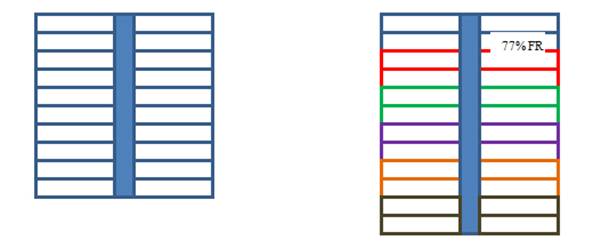
Events 24 days post-mating – regular returns – 2 sows and 1 gilt have
returned.
Example – one sow from the
farrowing batch group and one from the extra breeding group – demonstrated in
solid colours. These females are removed
and enter the next breeding batch or are culled.

Events 35 days post-mating
By 28 days – one sow
“extra” breeding group irregular return
By35 days – one
additional sows is confirmed not pregnant from the “extra” breeding group

Event – 6 weeks post-weaning
The empty stall in the farrowing
group is filled from the gilt pool or if the “lower farrowing rate” stall was
used and the sow is still pregnant from this stall. (This is used in this
example). The pregnant gilts remain in the gilt house to provide the (farrowing
place)*110% pregnant total batch.

Thus the ”extra” breeding group
is empty for use in the next batch.
Majority of the sows have not
been required to move.
The farm manager can clearly see
the breeding performance of each batch and can rapidly identify shortfalls –
which need to be rectified by additional gilts the next round.
Note – if there are more than
110% of farrowing place capacity confirmed pregnant at 6 weeks cull or abort
additional unwanted sows. Review culling policies.